
Last Updated on September 27, 2026 by Shakitha
If you want to choose between solar and battery security cameras, it may be difficult for you because they both offer convenient wireless installation and reliable home monitoring.
But the solar vs battery security cameras mainly differ in how they receive and store power.
If you take solar cameras, it uses sunlight to recharge their batteries.
And if you take battery cameras, it relies on rechargeable or replaceable batteries.
You should consider the factors such as sunlight availability, camera location, maintenance requirements, weather conditions and how often you want to recharge the camera.
In this guide, I will compare solar and battery security cameras and I will help you to understand their advantages, limitations, costs and which option is best for your home needs.
Solar vs Battery Security Cameras: Which Is Better in 2026?
What Is a Solar Security Camera?
Do you know conversion of sunlight into electricity?
This solar security camera works on this way.
A solar security camera is a wireless surveillance camera powered by a solar panel.
The sunlight energy is typically stored in a built-in rechargeable battery. It allows the camera to continue operating when sunlight is unavailable, such as night or during cloudy periods.
These solar security cameras are useful for monitoring areas where running power cables is difficult or expensive.
As like all security cameras, they can be installed around homes, garages, driveways, gardens, and remote outdoor locations.
The solar panel continuously helps recharge the battery. These type of cameras can reduce the need for frequent manual charging and it will provide a convenient low-maintenance security solution.
What Is a Battery Security Camera?
If you know about rechargeable batteries or replaceable batteries, this kind of battery security camera works that way.
A battery security camera is a wireless surveillance camera powered by a rechargeable or replaceable battery.
They work instead of a permanent electrical connection.
This kind of design makes installation easier because you don’t need to run any cables for the camera.
Read my post about highly rated 5 solar cameras which operate in cloudy weather to buy
These kinds of battery security cameras are suitable for monitoring entrances, driveways, garages, backyards, and other areas where it is difficult to install wires or inconvenient to install wires.
Based on your usage, the life of the battery can range from several weeks to several months before recharging or replacement is required.
In your camera, if you have features such as motion detection, live viewing, video quality, weather conditions, and recording frequency, it can affect how quickly the battery loses power.
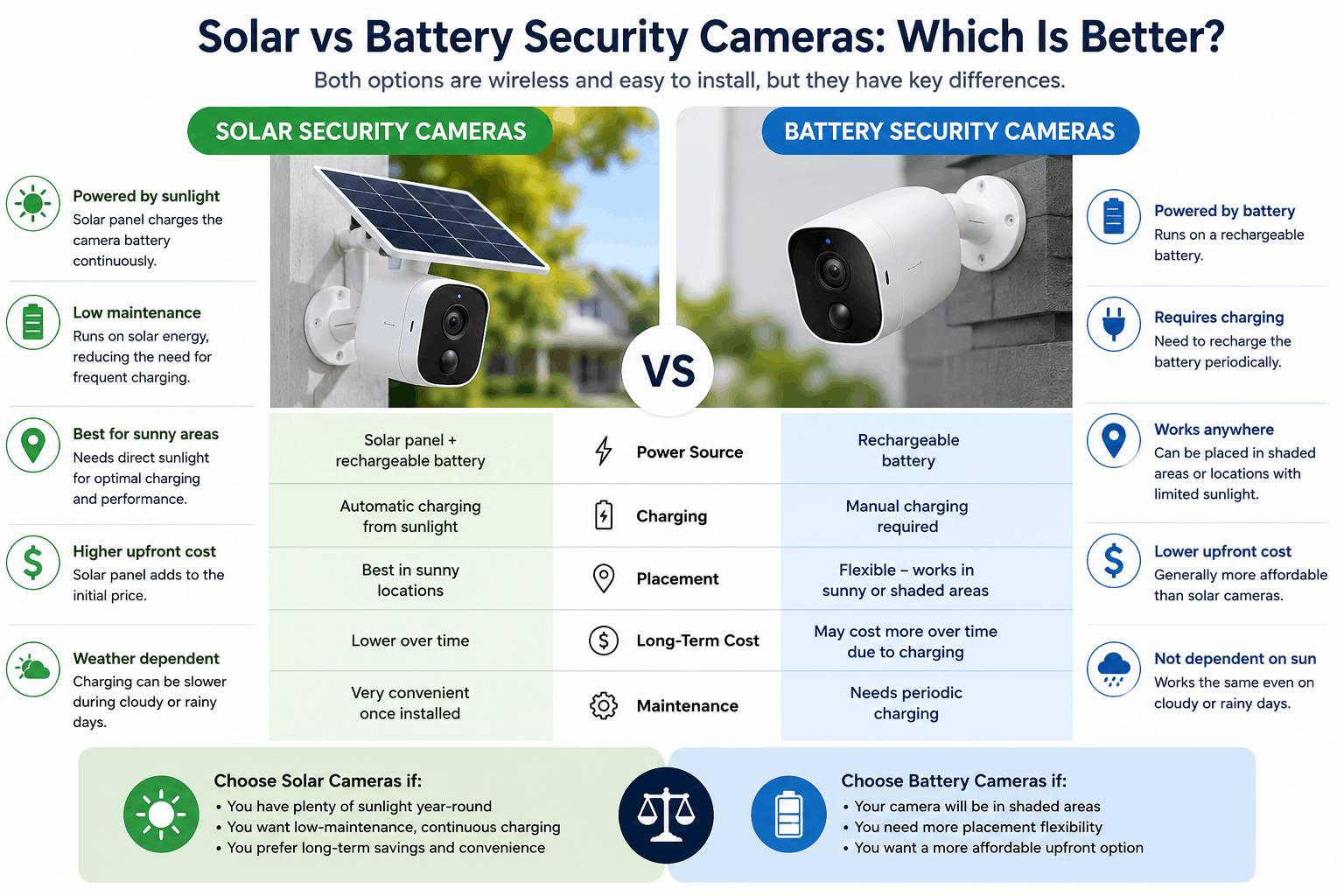
Solar vs Battery Security Cameras: Key Differences
| Feature | Solar Security Camera | Battery Security Camera |
|---|---|---|
| Power Source | Solar panel + rechargeable battery | Rechargeable or replaceable battery |
| Charging | Automatically charges from sunlight | Requires manual charging or battery replacement |
| Maintenance | Low maintenance | Requires periodic charging |
| Placement | Best for areas with good sunlight | Can be installed in sunny or shaded locations |
| Sunlight Dependency | Needs adequate sunlight for regular charging | Does not depend on sunlight |
| Cloudy Weather | Charging may decrease during extended cloudy periods | Performance is generally unaffected by sunlight |
| Installation | Wire-free, but solar panel positioning matters | Simple wire-free installation |
| Long-Term Convenience | Very convenient when properly positioned | Convenient but requires regular attention |
| Best For | Outdoor areas with reliable sunlight | Shaded areas, covered porches, garages, and flexible placements |
| Main Advantage | Reduces the need for manual charging | Greater installation flexibility |
| Main Disadvantage | Depends on available sunlight | Battery eventually needs recharging |
| Overall Maintenance | Lower | Moderate |
My advice for you,
If you are in a location with consistent sunlight and if you need less maintenance, you can choose solar cameras.
If you want to install the camera in a shaded location and if you need more flexibility then go for battery security camera.
How Do Solar Security Cameras Stay Charged?
Solar security cameras use solar panels to convert sunlight into electrical energy. So, they stay charged during daylight hours.
These panels generate power and send it to the camera’s rechargeable battery.
These rechargeable batteries store the energy and then can power the camera at night or when sunlight is not available.
Factors such as sunlight intensity, panel placement, weather, and seasonal changes, decide the amount of charging.
If you want a reliable performance, you should position the solar panel where it receives several hours of direct sunlight each day and you should keep it free from dirt, leaves, and other obstructions.
If you do like this, this can allow the camera to maintain its battery charge with minimal manual intervention.
How Long Do Battery Security Cameras Last?
If you take a battery security camera, it can typically operate for several weeks to several months on a single charge.
But the actual battery life varies based on the model and your usage.
Some of the factors like motion detection, live viewing, high resolution recording, night vision, and weak Wi-Fi signal can drain the battery faster.
If your camera records only when motion is detected, then it can last longer than models used for continuous monitoring.
Other factors like weather and temperature can also affect the battery performance, particularly in very cold conditions.
If you want to extend the battery life, you should adjust the settings on motion sensitivity.
You can reduce unnecessary recordings, limit live streaming, and you should have to maintain a strong wireless connection.
You should always check the manufacturer’s estimated battery life before purchasing a camera.
Solar vs Battery Cameras: Installation and Placement
| Installation & Placement Factor | Solar Security Camera | Battery Security Camera |
|---|---|---|
| Installation | Wire-free installation with a solar panel | Wire-free installation |
| Placement Flexibility | More limited because the panel needs sunlight | Highly flexible because it does not need sunlight |
| Best Locations | Sunny driveways, open yards, and exposed walls | Shaded areas, covered porches, garages, and side yards |
| Sunlight Requirement | Requires adequate sunlight for charging | No sunlight required |
| Panel Positioning | Panel should face an area with good sun exposure | No panel positioning required |
| Shaded Locations | Less suitable unless the panel can be installed separately | Well suited |
| Maintenance | Low, with occasional panel cleaning | Requires periodic battery recharging |
| Installation Planning | Requires planning for both camera coverage and solar exposure | Mainly focused on camera viewing angle and coverage |
| Best Choice For | Locations with reliable sunlight | Locations where flexible placement is more important |
How Do Solar and Battery Cameras Perform in Bad Weather?
Solar and battery security cameras are designed for outdoor use so they can both work in bad weather.
But the weather can affect their power performance differently.
If you are using the solar security camera the rain snow and heavy cloud can reduce the sunlight available to solar panels. It will limit how quickly the camera battery charges.
If you take battery cameras they are less dependent on sunlight but it may experience reduced battery performance in a very cold temperature.
Other factors like strong rain wind and extreme weather can also affect your camera visibility and wireless connectivity.
If you are choosing between the solar and battery security camera, first you should look for a weather resistant design, suitable outdoor rating and reliable battery performance across the temperature common in your area.
Solar vs Battery Security Cameras: Cost and Long-Term Value
| Cost & Value Factor | Solar Security Camera | Battery Security Camera |
|---|---|---|
| Upfront Cost | Usually higher because of the solar panel | Usually lower |
| Installation Cost | Often low with DIY installation | Often low with DIY installation |
| Charging Cost | No electricity cost for solar charging | Requires electricity for recharging |
| Battery Replacement | Less frequent charging can reduce battery maintenance | Battery may need more frequent charging or eventual replacement |
| Maintenance | Generally lower after proper installation | Requires periodic charging |
| Long-Term Convenience | High because the solar panel can continuously recharge the battery | Moderate because manual charging is required |
| Weather Dependence | Charging can decrease during prolonged cloudy or rainy periods | Not dependent on sunlight |
| Best Long-Term Value | Excellent for sunny outdoor locations | Excellent for shaded areas and flexible placement |
| Ideal Use | Long-term outdoor monitoring | Temporary, shaded, or frequently repositioned monitoring |
| Overall Value | Higher long-term convenience | Lower initial investment |
Frequently Asked Questions
1. Are solar security cameras better than battery cameras?
Solar security cameras can be better for sunny outdoor locations because the solar panel helps recharge the battery automatically. Battery cameras are more flexible for shaded or covered areas.
2. Do solar security cameras work without sunlight?
Yes. Most solar security cameras store energy in a rechargeable battery, allowing them to continue operating at night or during short periods of cloudy weather.
3. How often do battery security cameras need charging?
Charging frequency depends on the camera, battery capacity, motion activity, video quality, and usage. Some models can operate for several weeks or months before needing a recharge.
4. Which is easier to install, solar or battery cameras?
Both can be relatively easy to install because they are usually wireless. Battery cameras offer more placement flexibility because they do not require sunlight for charging.
5. Which camera is better for long-term use?
Solar cameras can be more convenient for long-term outdoor monitoring because they reduce the need for manual charging. Battery cameras may be better when the installation location is shaded or frequently changed.