
Last Updated on July 5, 2026 by Shakitha
One of the most important factors to consider while choosing a home security camera is security camera field of view, FOV.
If you place your security camera with the right viewing angle, it can cover more area, reduce blind spot, and it will help you to monitor your property more effectively.
But a wider field of view is not always the best choice.
Do you know why?
Because it can sometimes reduce image detail at longer distances.
In this post, I will show you what security camera field of view means, why it matters, how it is measured, and how to choose the ideal viewing angle for different areas of your home.
Security Camera Field of View Explained
What Is Security Camera Field of View?
Do you know what is security cameras field of view, FOV?
It is the total area the camera can capture at one time.
Usually, it is measured in degrees with common viewing angles ranging from 60 degree to 180 degree.
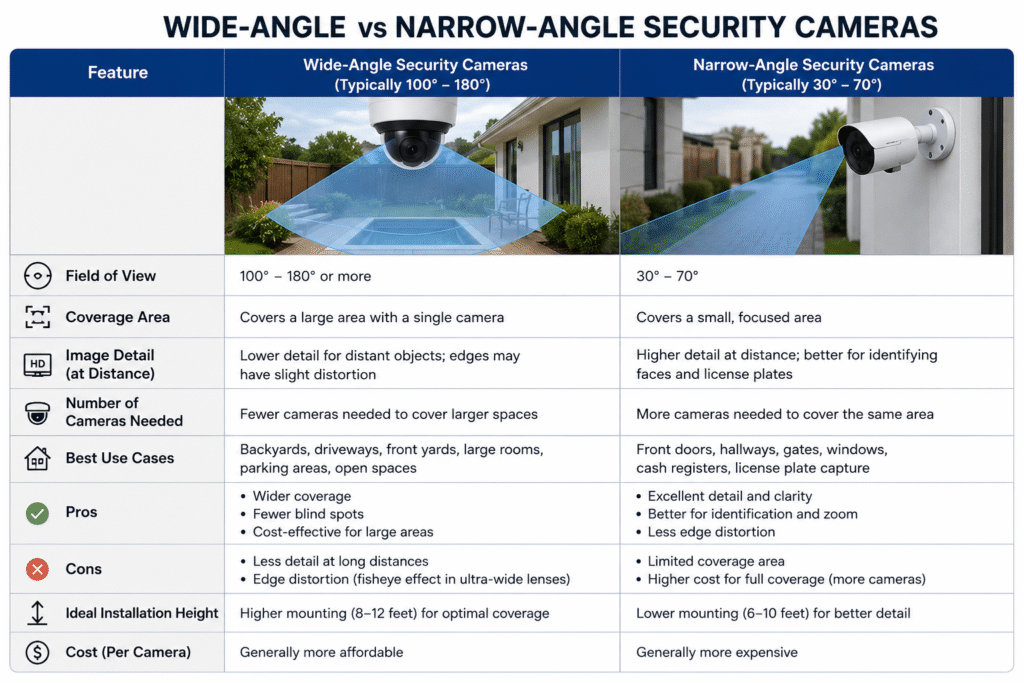
If your camera has a wider field of view, it allows a single camera to monitor a larger space.
But if your camera has a narrower angle, it focuses on a small area with greater detail.
Basically, this ideal field of view depends upon the camera, where it is installed, and what you want to monitor.
If you understand FOV, it helps you to choose the right security camera, to minimize blind spots and achieve better coverage without installing more cameras than necessary.
How Is a Security Camera’s Field of View Measured?
Usually, this security camera’s field of view is measured in degrees.
It indicates how wide an area the camera can capture from left to right.
In the market, most of the home security cameras offer viewing angle between 90 degree and 180 degree. It depends upon the lens design.
If your camera has a larger degree, it means it covers more space, while a smaller degree camera provides a narrower but more detailed view.
The manufacturer of the camera determine the field of view based on the camera’s focal length and sensor size.
If you compare cameras, always consider both the viewing angle and image resolution.
It will make you ensure to get the right balance between wide coverage and clear recognizable details.
Why Field of View Matters for Home Security
This field of view plays an important role in determining how effectively your security camera protects your home.
If your camera comes with the right viewing angle, it can monitor larger areas, decrease the number of cameras, it reduces the blind spots to cover your property.
If you take an example, I can say that, a wide angle camera is ideal for backyards, driveways and open spaces, and a narrower field of view camera works better for entrances where capturing facial details is important.
If you choose the right and appropriate field of view, it improves overall surveillance, enhances security, and it will help you to make the most of your investment by ensuring the area is properly monitored.
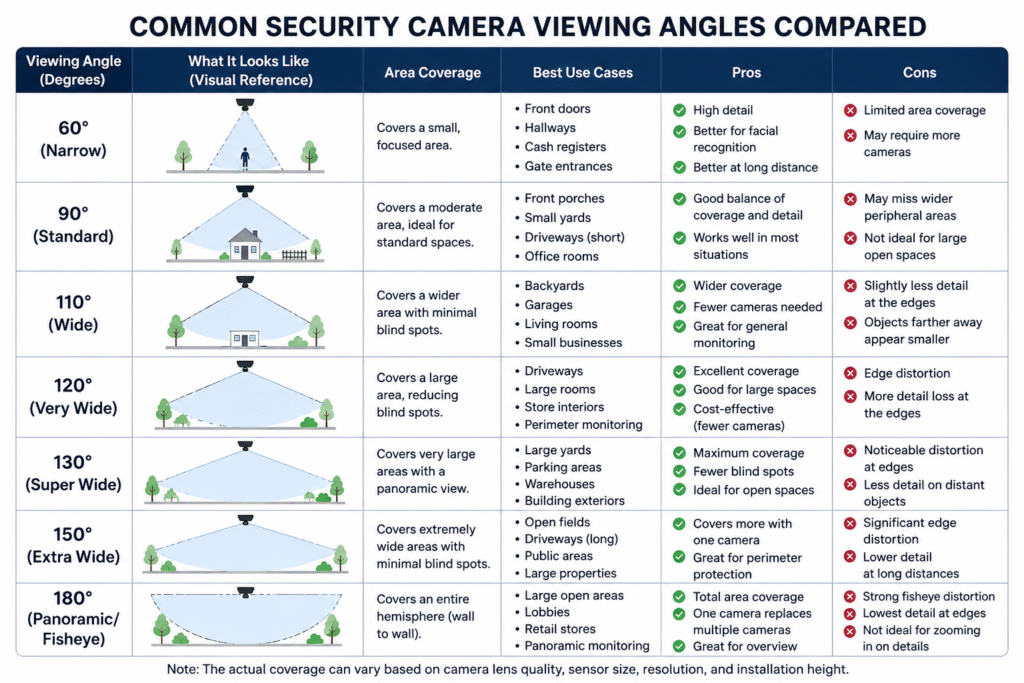
Common Security Camera Viewing Angles Compared
i have provided a easy comparison table for your better understanding,
Wide-Angle vs Narrow-Angle Security Cameras
How Field of View Affects Image Quality
Generally your security camera’s field of view directly affects the image quality and the level of detailing present in the image.
If your camera has a wide field of view it can cover more area but their image resolution across the larger scene may be spread. It makes the distinct objects appear smaller and less detailed. So, this can make it harder to identify faces or read license plate at longer distances.
On the other hand, if your camera is with a narrower field of view it will concentrate pixels on a smaller area, so it produces sharper images and better identification.
If you want to achieve the best result, you should choose a camera that balances field of view, resolution and installation location based on your specific security needs.
How to Choose the Right Field of View for Different Areas of Your Home
| Home Area | Recommended Field of View | Why It’s Recommended | Best Camera Type |
|---|---|---|---|
| Front Door | 90°–110° | Captures visitors clearly while maintaining facial detail. | Doorbell camera or bullet camera |
| Back Door | 90°–120° | Covers the entrance and surrounding area without excessive distortion. | Bullet or turret camera |
| Driveway | 110°–140° | Monitors parked vehicles and approaching people over a wider area. | Bullet or turret camera |
| Garage | 100°–120° | Covers vehicles, storage space, and entry points effectively. | Turret or dome camera |
| Backyard | 120°–160° | Provides broad coverage of large outdoor spaces and reduces blind spots. | Wide-angle outdoor camera |
| Front Yard | 120°–150° | Monitors walkways, landscaping, and the approach to your home. | Wide-angle bullet camera |
| Living Room | 110°–130° | Covers high-traffic indoor areas with minimal blind spots. | Indoor dome camera |
| Hallway | 70°–90° | A narrower angle is sufficient for long, narrow spaces and captures better detail. | Bullet camera |
| Side Entrance | 90°–110° | Focuses on a specific access point while maintaining image clarity. | Bullet or turret camera |
| Large Open Areas | 150°–180° | Maximizes coverage with fewer cameras, though edge distortion may occur. | Panoramic or fisheye camera |
Below, I have provided a quick tips, for your better understanding and decision making,
| If You Want To… | Choose This Field of View |
|---|---|
| Capture faces and fine details | 70°–90° |
| Balance coverage and image quality | 90°–120° |
| Monitor large outdoor spaces | 120°–150° |
| Cover the widest possible area with one camera | 180° panoramic |
| Reduce the number of cameras needed | 120°–180° |
| Avoid blind spots in open areas | 130°–180° |
Frequently Asked Questions (FAQs)
1. What is the best field of view for a home security camera?
The best field of view depends on where the camera is installed. A 90°–110° angle is ideal for front doors and entrances, while 120°–150° works well for driveways, backyards, and other large outdoor areas.
2. Does a wider field of view mean better security?
Not always. A wider field of view covers more area but may reduce image detail at longer distances. The best option balances coverage with the level of detail you need.
3. Is a 180-degree security camera worth it?
A 180-degree camera is excellent for monitoring large open spaces with a single device. However, it may introduce edge distortion and provide less detail for distant objects than narrower-angle cameras.
4. How does field of view affect image quality?
As the field of view increases, the camera spreads its resolution across a larger area. This can make faces, license plates, and other distant objects appear smaller and less detailed.
5. What field of view is best for a front door camera?
A field of view between 90° and 110° is generally ideal for front doors because it captures visitors clearly without sacrificing facial recognition or image quality.
6. Can one wide-angle camera replace multiple cameras?
In some situations, yes. A wide-angle camera can cover a larger area and reduce the number of cameras needed, but multiple cameras may still be necessary to eliminate blind spots and capture fine details.
7. Does lens size determine a camera’s field of view?
Yes. The lens focal length plays a major role in determining the field of view. Shorter focal lengths produce wider viewing angles, while longer focal lengths create narrower, more focused views.
8. What is the difference between field of view and viewing distance?
Field of view refers to how wide an area the camera can see, while viewing distance refers to how far the camera can capture usable images. Both factors are important when selecting a security camera.
9. Are wide-angle security cameras good for indoor use?
Yes. Wide-angle cameras are ideal for monitoring living rooms, garages, and other large indoor spaces because they provide broad coverage with fewer blind spots.
10. How can I choose the right field of view for my home?
Consider the size of the area, the level of detail you need, the camera’s resolution, and its mounting location. Matching the field of view to each specific area ensures better coverage, fewer blind spots, and more effective home security.