
Last Updated on July 12, 2026 by Shakitha
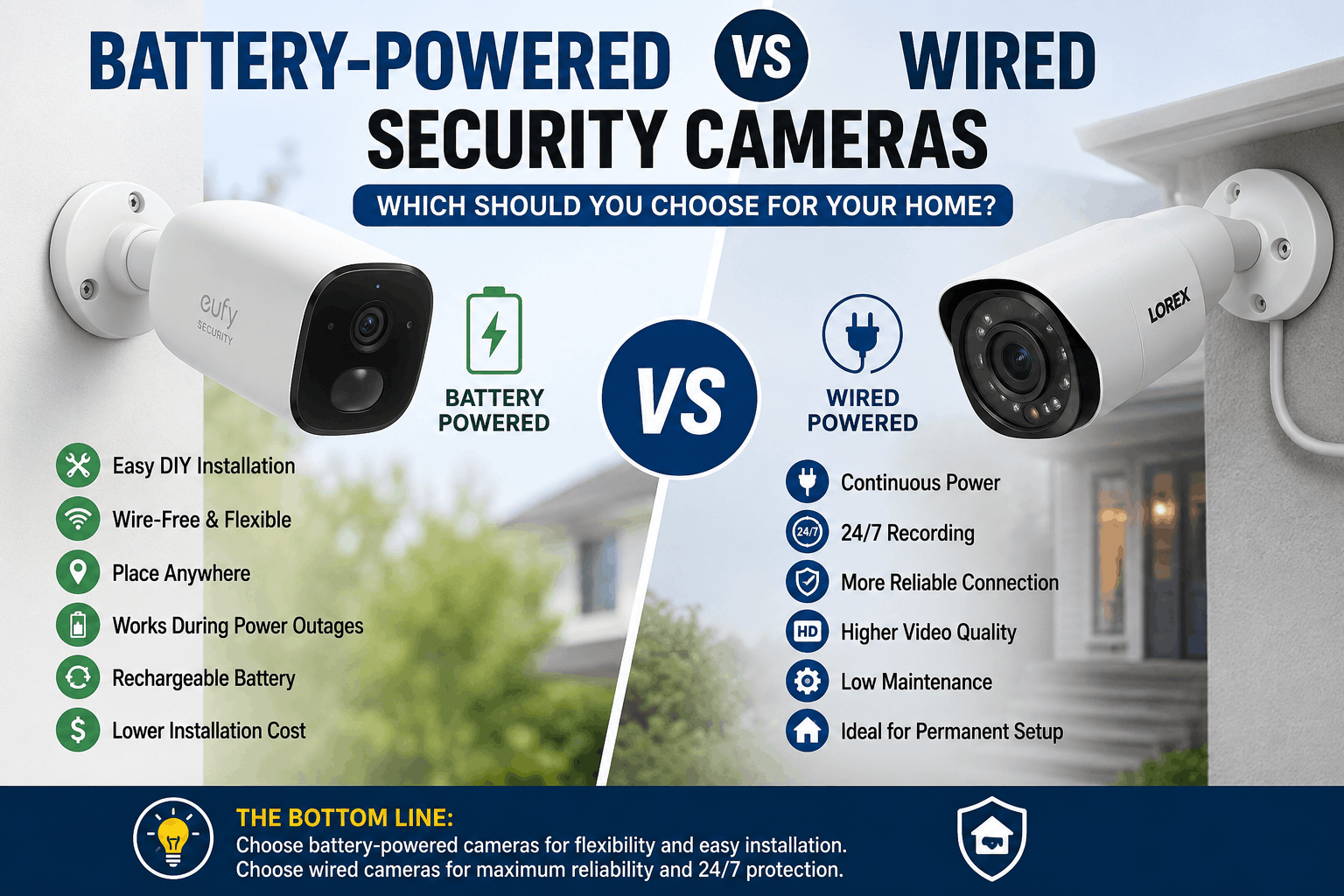
When you’re building a powerful home security system, choosing between the battery-powered and wired security cameras is one of the most important decisions you have to make.
I can say that, both options help protect your property, but they differ in installation, maintenance, reliability, and overall performance.
If you are a renter or have a smaller home, battery-powered cameras offer flexibility and quick DIY setup.
But if you use wired security cameras, it will provide continuous power, stable performance and 24/7 recording for maximum protection.
In this guide, I will show you and compare battery-powered vs wired security cameras and explore their pros and cons, which will help you to determine which option best suits for your home, budget and security needs.
Battery-Powered vs Wired Security Cameras: Which Should You Choose ?
What Is the Difference Between Battery-Powered and Wired Security Cameras?
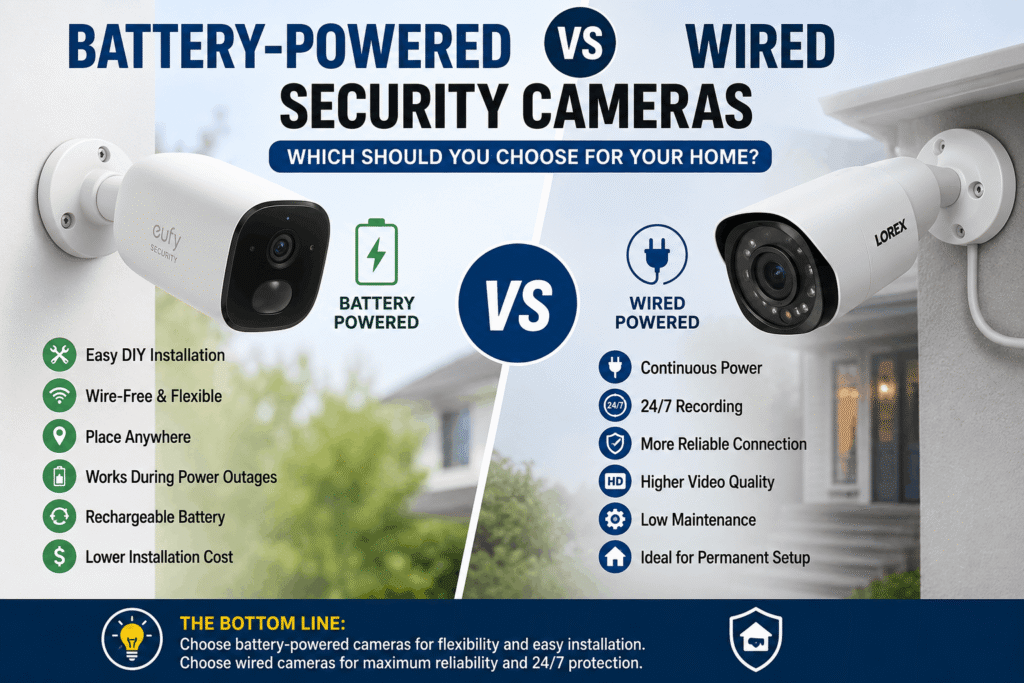
I have provided the difference between the both as a comparison chart for your easy understanding below,
| Feature | Battery-Powered Security Cameras | Wired Security Cameras |
|---|---|---|
| Power Source | Rechargeable or replaceable batteries | Continuous power through electrical wiring or PoE |
| Installation | Quick DIY installation with no wiring required | More complex installation; may require professional help |
| Placement Flexibility | Can be installed almost anywhere within Wi-Fi range | Limited by power outlets and cable routing |
| Recording Type | Typically motion-activated recording to conserve battery | Supports continuous 24/7 recording and motion detection |
| Maintenance | Requires periodic battery charging or replacement | Minimal maintenance once installed |
| Reliability | May stop recording if the battery is depleted | Consistent performance with uninterrupted power |
| Video Quality | Excellent HD/2K/4K options, but battery-saving modes may affect performance | Consistently high video quality with no power-saving limitations |
| Internet Connectivity | Usually connects via Wi-Fi | Available in wired Ethernet (PoE) or Wi-Fi models |
| Best For | Renters, apartments, temporary setups, and DIY users | Homeowners, large properties, and permanent security systems |
| Initial Cost | Lower installation cost but ongoing battery maintenance | Higher installation cost but lower long-term maintenance |
| Long-Term Cost | Battery replacements or charging may add to costs | Lower recurring costs after installation |
| Weather Performance | Depends on battery life in extreme temperatures | Generally more reliable in very hot or cold climates |
| Scalability | Easy to add or relocate cameras | Expanding the system may require additional wiring |
| Ideal Users | Users seeking convenience and flexibility | Users prioritizing maximum reliability and continuous monitoring |
The key takeaway is,
If you are the user, who wants an easy to install, flexible, and portable security solution, then battery-powered security cameras are ideal for you.
And if you are a homeowner who need uninterrupted power, continuous recording, and highest level of reliability, then wired security cameras is best suited for you.
But you should keep in mind, that your choice ultimately depends on your budget, property type, and long-term security requirements.
You can read my article, the number of security cameras needed for your home, here
Pros and Cons of Battery-Powered Security Cameras
Pros of Battery-Powered Security Cameras
- Easy DIY Installation: No electrical wiring is required, making setup quick and beginner-friendly.
- Flexible Placement: Cameras can be installed almost anywhere within Wi-Fi range, including areas without power outlets.
- Portable and Relocatable: Easily move the camera to a new location when your security needs change.
- Ideal for Renters: Perfect for apartments and rental properties where drilling or permanent wiring is restricted.
- Lower Installation Costs: Eliminates the need for professional installation, reducing upfront expenses.
- Works During Power Outages: Since they rely on batteries, they can continue operating even when household electricity is unavailable (if Wi-Fi remains active or supported by backup power).
Cons of Battery-Powered Security Cameras
- Regular Battery Charging or Replacement: Batteries must be recharged or replaced periodically, depending on usage.
- Limited Continuous Recording: Most models record only when motion is detected to conserve battery life.
- Performance Depends on Battery Level: Low battery can affect reliability if not maintained properly.
- Weather Can Reduce Battery Life: Extremely hot or cold temperatures may shorten battery performance.
- Possible Missed Events: Recording delays or cooldown periods on some models can result in missed activity.
- Ongoing Maintenance: Requires regular monitoring of battery status and timely recharging to ensure uninterrupted protection.
Pros and Cons of Wired Security Cameras
Pros of Wired Security Cameras
- Continuous Power Supply: Receives constant power, eliminating the need to recharge or replace batteries.
- 24/7 Continuous Recording: Supports around-the-clock video recording for complete surveillance coverage.
- Highly Reliable Performance: Provides a stable connection with fewer interruptions than battery-powered models.
- Superior Video Quality: Consistently delivers high-resolution footage without battery-saving limitations.
- Low Ongoing Maintenance: Once installed, the system requires very little routine maintenance.
- Ideal for Large Properties: Well-suited for permanent installations in homes, offices, and commercial buildings.
Cons of Wired Security Cameras
- Complex Installation: Requires running power or Ethernet cables, making installation more time-consuming.
- Higher Upfront Costs: Professional installation and wiring can significantly increase the initial investment.
- Limited Placement Flexibility: Camera locations are restricted by cable length and available power sources.
- Difficult to Relocate: Moving cameras usually involves rerouting cables and additional installation work.
- May Stop During Power Outages: Standard wired cameras can lose power unless connected to a backup power source or UPS.
- Visible Cables Can Be Vulnerable: Exposed wiring may affect aesthetics and can be damaged or tampered with if not properly protected.
Which Camera Type Is Easier to Install?
With 10 years of experience, I can say that when it comes to installation, battery-powered security cameras are generally the easier and best option for you.
Battery-powered security cameras require no electrical wiring. So, you can mount them with basic tools and complete the setup in minutes using a mobile app.
Since there are no wires, it also makes it simple to reposition them if your security needs change.
On the other hand, if you take wired security cameras, it requires power cables or Ethernet connections to involve drilling, running wires through the walls, and configuring recording equipment.
Wired security cameras offer a permanent and reliable solution. Installation is often more time-consuming, and it provides a permanent solution, but it requires professional assistance, especially for larger homes or multi-camera systems.
Which Offers Better Video Quality and Reliability?
Since wired security cameras receive continuous power and maintain a stable connection, it offers better video quality and reliability.
For example,
it can record 24/7 in high resolutions such as 2K or 4K without worrying about battery life. It makes them ideal for continuous surveillance.
On the other hand, if you take battery-powered cameras, it provides excellent image quality, but many conserve energy by recording only when motion is detected.
Since battery-powered cameras are operated by battery, their performance can be affected by low battery level or extreme weather condition.
If your priorities are uninterrupted monitoring and consistent performance, you can choose wired cameras.
If you are in need of convenience and flexible placement, battery-powered cameras remain an excellent choice for you.
Which Security Camera Is Better for Indoor and Outdoor Use?
Depending upon your homes layout, and security needs, you should choose the best security camera for indoor and outdoor.
If you take battery-powered cameras, they are ideal for indoor spaces, apartments, garages, and outdoor areas when running electrical cable is difficult.
You can expect flexible placement, which makes it perfect for renters or homeowners who want a simple DIY installation.
If you take wired security cameras, they are best suited for permanent outdoor monitoring, large properties, driveways, and entrances that requires continuous recording and reliable performance.
What my suggestion for you is,
for maximum protection, you can choose a hybrid setup using wired cameras for critical outdoor areas and battery-powered cameras for indoors or in locations which needs flexible coverage.
How to Choose the Right Security Camera for Your Home
To choose the right security camera for your home, first you should evaluate your home size, budget, and security priorities.
If I need a quick, affordable, and easy to installation solution, I go for battery powered cameras. Especially, it will suit for renters and smaller homes.
If I require continuous recording, maximum reliability, and long-term performance, I will go for wired security cameras.
You should also consider factors like video resolution, night vision, motion detection, storage option, smart home compatibility, and whether resistant for outdoor use.
You should match these features to your specific needs and you can build a security system which provides dependable protection and peace of mind.