
Last Updated on May 29, 2026 by Shakitha
While dealing with bumpy, uneven or rough lawns, choosing the best wheel size for your electric lawnmower is essential.
You can improve traction, stability, maneuverability, and overall mowing performance by choosing the right wheel choice.
If your rear wheels are larger, it will help the mower glide smoothly over dips, bumps, and thick grass while reducing operator fatigue.
If you choose electric lawnmower with smaller wheels, it may work well on flat surfaces, but it will struggle on uneven ground.
First, you should understand how wheel diameter and width affect lawnmower handling. It will help you to select the ideal mower for your yard.
In this guide, I will explore the best wheel size for electric lawn mowers on bumpy lawns.
Best Wheel Size for Electric Lawn Mowers on Bumpy Lawns
Why Wheel Size Matters on Bumpy Lawns
While your electric lawnmower handles bumpy and uneven lawns, your wheel size plays a major role in how effectively it works.
If you use an electric lawnmower with larger wheels, it can roll more smoothly over rocks, holes, rough patches, and uneven ground.
It won’t get stuck or bounce excessively. It improves traction and stability and makes the mower easier to control on slopes or challenging terrain.
On the other hand, if you choose an electric lawnmower with small wheels, it may struggle on rough lawns causing jerky movement and uneven cutting performance.
So, proper wheel size helps reduce physical effort while improving maneuverability and moving efficiency.
If you choose a mower with the right wheel dimension, you can ensure a smoother mowing experience and you can maintain a cleaner, more even lawn appearance.
Understanding Front Wheel vs Rear Wheel Sizes
While choosing an electric lawnmower for bumpy lawns, first you should understand the difference between the front wheel and rear wheel sizes.
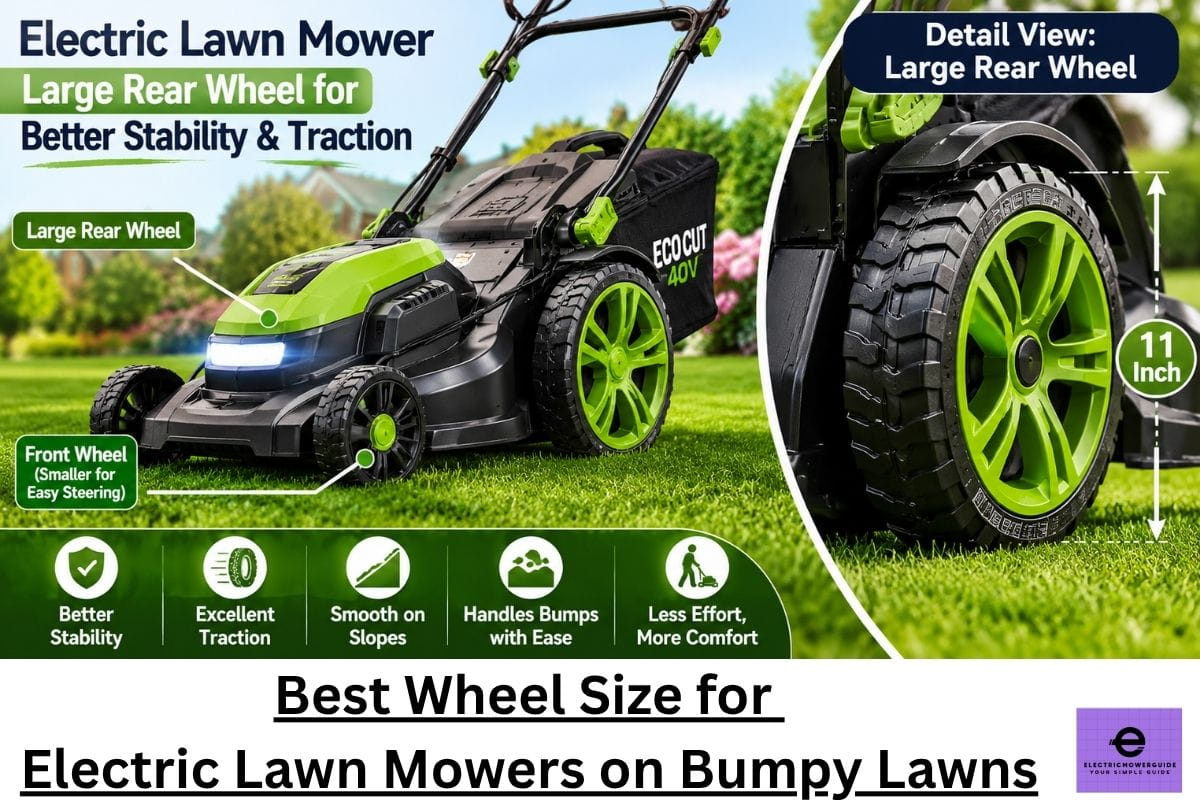
If you see the front wheels of your electric lawnmower, they are usually smaller in size because it mainly assist with steering and maneuverability around obstacles and tight corners.
On the other hand, if you see rear wheels of your electric lawnmower, they are often larger in size to provide better traction, stability, and support on uneven terrain.
These high rear wheels help the mower move smoothly over bumps, dips, and thick grass while reducing strain on the user.
A mower with smaller front wheels and larger rear wheels offers balanced handling and improved control.
This type of wheel combination is ideal for sloped, rough, or uneven lawn conditions.
Best Rear Wheel Size for Uneven Terrain
With my 10 years of experience in lawn mowing, I can say that the best rear wheel size for electric lawn mowers on uneven terrain is typically between 10 to 12 inches.
If you choose larger rear wheels, it will provide better traction stability and smoother movement across rough ground bumps and shallow holes.
These larger rear wheels help the mower maintain balance while reducing vibration and operator fatigue during longer mowing sessions.
It will also make it easier to push or guide the mower through thick grass and sloped areas.
If you choose smaller rear wheels, it may struggle on rough surfaces and it can cause uneven cutting performance.
If you choose a mower with larger rear wheels, it will improve handling comfort and overall mowing efficiency on challenging lawns.
How Larger Wheels Improve Stability and Traction
If you choose larger rear wheels on your electric lawn mower, it will significantly improve the stability and traction when mowing your bumpy or uneven lawns.
This increased diameter of the wheels allows the mower to roll more easily over obstacles such as dips, rough patches and bumps without getting stuck or losing balance.
Since it moves smoothly, it reduces the sudden jerks and it will help to maintain a consistent cutting height.
If the rear wheels are larger, it increases the contact area with the ground and improve grip on soft, wet or sloped surfaces.
As a result, the mower feels easier to control and it requires less physical effort from you.
Overall, if you choose a mower with larger wheels, it contributes safer, more stable and more efficient mowing performance.
Small Wheels vs Large Wheels: Which Performs Better?
If you compare small wheels and large wheels on electric lawn mower for your uneven terrain, you can see the performance difference between the both.
If you choose small wheels, they are better suited for flat smooth lawns. They can offer easy maneuverability and lighter weight handling.
But smaller wheels struggle on bumpy or rough ground and it will get stuck or cause uneven cuts.
On the other hand, if you choose larger wheels, it can excel on uneven sloped or rough lawns due to better traction, stability, and smoother rolling over obstacles.
It reduces the operator effort and improves the cutting efficiency.
Overall, if you choose large wheels, it can perform better for challenging terrains. But if you choose small wheels, they are ideal for simple level mowing conditions.
Ideal Wheel Size for Sloped and Rough Lawns
While choosing the ideal wheel size for sloped and rough lawns, it is generally on the larger side, especially for the rear wheels of your electric lawn mower.
If you choose wheel diameter of around 10 to 12 inches, it can provide better grip, balance, and control when navigating inclines and uneven surfaces.
If you choose larger wheels, you can reduce the risk of slipping on slopes, and it will help the mower move smoothly over dips, bumps, and thick grass patches.
In addition to that, it can make steering easier and reduce the strain on the user during longer mowing sessions.
If you choose a mower with appropriately sized wheels, you can ensure safer operation, improved stability, and a more even, professional-looking lawn finish.
Factors to Consider Before Choosing Wheel Size
There are several factors you should consider before choosing wheel size for your electric lawnmower.
If you consider these factors, you can ensure optimal performance.
First, you should evaluate your lawn terrain, whether it is bumpy, sloped, or uneven lawn. If it is so, it requires larger wheels for better stability.
Second, you should consider the thickness and grass type, because a dense grass may need stronger traction.
Third, think about the mower weight. Because if you choose heavier models, it can benefit from bigger wheels for easier movement.
The fourth factor is to check maneuverability needs. If you choose smaller wheels, it can perform better in tight spaces.
The final factor you should consider is storage and portability, if your space is limited.
If you balance these factors while choosing the wheel size, you can select the right wheel size for efficient, comfortable, and safe mowing.