
Last Updated on August 10, 2026 by Shakitha
If you want to maximize sunlight exposure to improve energy production, choosing the best direction to mount a solar panel is important.
If you choose solar panels, it works best when they receive several hours of direct sunlight each day. But, the direction to mount a solar panel differs depending on your location, roof orientation, shading, and the time of day you use the most electricity.
Totally, in general, south-facing panels are often preferred in the northern hemisphere because they receive strong sunlight throughout the day.
But, and also east or west-facing panels can also perform well in certain situations.
If you understand the solar panel direction and orientation, it can help you to get better performance and make the most of your solar investment.
Best Direction to Mount a Solar Panel: North, South, East or West?
What Is the Best Direction to Mount a Solar Panel?
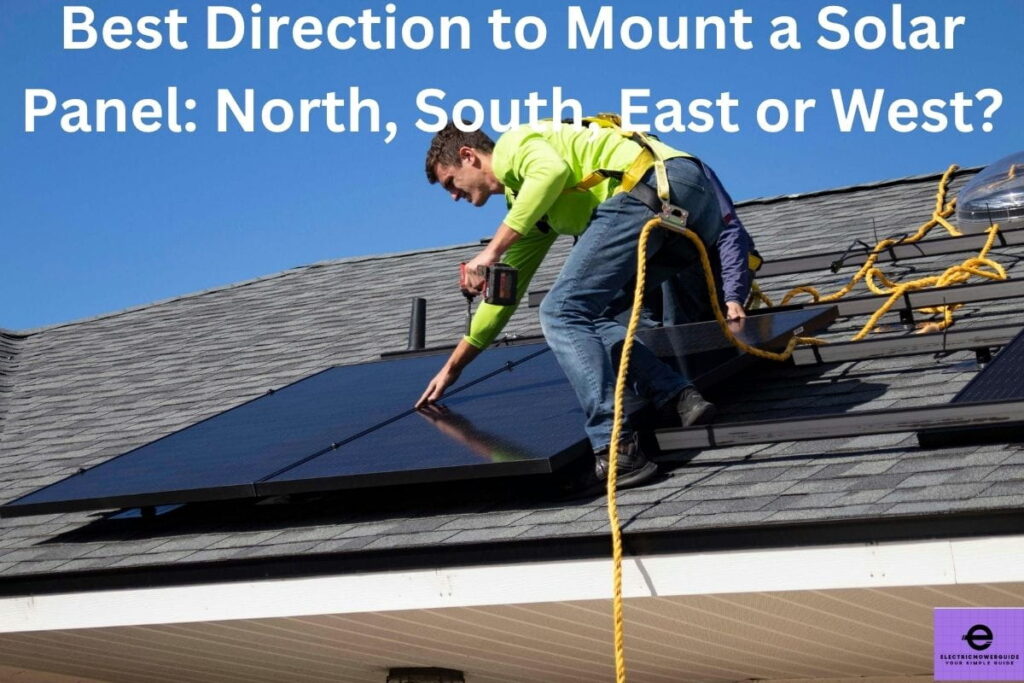
If you want to know the best direction to mount a solar panel, it depends on your location and the path of the sun throughout the day.
If you are living in a northern hemisphere, which includes United States, south-facing solar panels are generally considered the best option because they receive consistent sunlight across the day.
If you place in the south orientation, it can help maximize annual solar energy production where there are no major shading problems.
However, east or west-facing panels can also be effective, especially when electricity usage is higher in the morning or afternoon.
If you want to install a solar panel, you should first consider your roof direction, nearby trees or buildings, seasonal sunlight, and the panels tilt angle to achieve the best overall performance.
Why Solar Panel Direction Matters for Energy Production
Placing the solar panel in the right direction affects how much sunlight your panel receives throughout the day.
If you place your panel toward the sun, generally capture more solar energy, and it can increase your electricity production and improve the overall efficiency of your system.
If you place your panel poorly, it may receive less direct sunlight, especially during important peak sun hours, reducing its energy output.
I can say that, the ideal direction depends on your location, roof orientation, seasonal sun position, and shading from trees or nearby buildings.
If you choose the right direction, it can help you generate more electricity from the same number of panels, also it potentially reduces your reliance on grid power, and it improves the long-term value of your solar investment.
Is South-Facing the Best Direction for Solar Panels?
If your home is situated in the Northern Hemisphere, South facing solar panels are generally considered as one of the best orientations because they can receive sunlight for much of the day.
If you place your solar panel facing South, it can provide consistent solar exposure from morning through afternoon and also it helps you to maximize annual energy production.
But, I can also say that, South is not always the only suitable option. If you place your panel in East, it can also produce more electricity during the morning.
If you place your panel in West, it can perform better later in the afternoon.
Factors like roof shading, local climate, panel tilt and household electricity usage can also influence the ideal direction.
Therefore, South facing is usually a strong choice I can prefer, but the best orientation depends on your specific location and installation conditions.
Can You Mount Solar Panels Facing East or West?
The short answer is yes.
You can place solar panels facing east or west. These orientations can work well depending upon your energy needs and roof layout.
If you place your panel facing east, it receives more sunlight during the morning. It makes them useful for homes that consume more electricity early in the day.
If you place your solar panel facing west, it receives stronger sunlight during the afternoon and evening, and it can be beneficial when electricity usage is higher later in the day.
With my 10 years of experience, I can say that, if you place solar panel facing east or west, it may produce less total amount of energy than the ideal south-facing system in many northern hemisphere locations,
But still, they can provide good performance.
If you minimize the shading and if you choose an appropriate tilt, it can provide you the best performance.
Is North-Facing a Good Direction for Solar Panels?
I can say that north-facing solar panels are generally less favorable in the northern hemisphere.
You know why?
Because they typically receive less direct sunlight throughout the year.
When you place panels away from the sun’s strongest path, their overall energy production can decrease, and particularly during peak sunlight hours.
But north-facing installation may still be practical when roof limitations, shading, or property design make other directions unsuitable.
If you tilt the panel and adjust, it can also help you to improve performance.
You should first consider your location, because solar orientation recommendations differ based on hemispheres.
If you are choosing a north-facing installation, you first evaluate annual sunlight exposure, roof angle, shading, and expected energy consumption to determine whether it is a worthwhile installation.
Best Solar Panel Direction by Time of Day
First, you should find your ideal solar panel direction. You can find it by knowing when your household uses the most electricity.
When you face your solar panel facing east, it generally receives stronger morning sunlight.
If you place in the west, it can capture more afternoon and evening sunlight.
But if you face your panel facing south, they are often preferred in the Northern Hemisphere for balanced exposure throughout the day.
I have provided a comparison table below, for easy understanding,
| Time of Day | Best Direction | Why It Works Best |
|---|---|---|
| Early Morning | East | Captures stronger morning sunlight |
| Late Morning | Southeast / South | Receives increasing direct sunlight |
| Around Midday | South | Typically receives strong, balanced sunlight |
| Early Afternoon | South / Southwest | Continues receiving strong sunlight |
| Late Afternoon | West | Captures more afternoon sunlight |
| Evening | West | Extends useful solar production later in the day |
But, you must keep in mind, that actual performance varies depending upon your location, season, shading and the sun’s path.
How Roof Orientation Affects Solar Panel Performance
One of the important factors you should keep in mind is the roof orientation.
The roof orientation plays an important role in determining how much sunlight your solar panel receive throughout the day.
If you place the roof in a favorable direction, it can provide longer exposure to direct sunlight, and also it helps to increase electricity production.
Up to my knowledge, in the northern hemisphere, south-facing roofs are generally well-suited for solar installation.
But eastern and west-facing roofs can also provide useful energy production.
However, if you face north, roofs may receive less direct sunlight in many locations.
Roof orientation is not the only factor to consider. You should also consider roof pitch, nearby trees, buildings, seasonal sun angles and shadings. These can also affect your performance.
If you evaluate your roof orientation before installation, it can help you to choose the most effective panel placement.
What Is the Best Solar Panel Angle for Maximum Sunlight?
I can say that the best solar panel angle depends on your geographic location and the sun’s position throughout the year.
But in generally, solar panel perform best when they are tilted towards the sun rather than installed completely flat.
If you are doing fixed installation, you should tilt to close to the location’s latitude. It often useful starting point, although adjusting the angle seasonally can improve the production.
I have provided a table below, which provides general guidance for different panel angles.
| Solar Panel Angle | Typical Performance | Best Use |
|---|---|---|
| 0° (Flat) | Lower | Flat roofs where mounting options are limited |
| 10°–20° | Moderate | Low-slope roofs and some warmer regions |
| 20°–30° | Good | Many residential installations |
| 30°–40° | Very Good | Common range for many locations |
| 40°–50° | Good | Higher-latitude locations |
| 50°+ | Variable | High-latitude areas or specific seasonal needs |
Please note that,
if you are doing fixed installation, you should first consider the angle that provides good year-round sunlight rather than focusing only on one season.
Frequently Asked Questions
- What is the best direction to mount a solar panel?
In the Northern Hemisphere, south-facing is generally the best direction for maximizing annual solar energy production. However, east- and west-facing panels can also work well depending on your roof and electricity usage. - Can solar panels face east?
Yes. East-facing panels receive more sunlight during the morning and can be useful for homes with higher morning electricity consumption. - Can solar panels face west?
Yes. West-facing panels can capture more afternoon and evening sunlight, making them useful when household electricity demand is higher later in the day. - Are north-facing solar panels effective?
North-facing panels are generally less effective in the Northern Hemisphere because they typically receive less direct sunlight. However, they may still be practical in certain situations. - What is the ideal angle for solar panels?
The ideal angle depends on your location and latitude. A tilt close to your latitude is often a good starting point for fixed solar panels. - Does roof direction affect solar panel performance?
Yes. Roof orientation determines how much direct sunlight panels receive throughout the day and can significantly affect energy production. - Do solar panels need to face the sun directly?
Panels do not need to face the sun perfectly at every moment, but better orientation toward the sun generally improves energy production. - Is a flat roof suitable for solar panels?
Yes. Solar panels can be installed on flat roofs using mounting systems that provide an appropriate tilt and orientation. - Does shading affect solar panel direction?
Yes. Trees, buildings, chimneys, and other obstructions can reduce solar production. Avoiding shade can sometimes be more important than achieving a perfect orientation. - What is more important: solar panel direction or angle?
Both matter. Direction determines when the panel receives sunlight, while the tilt angle affects how directly sunlight strikes the panel. A good combination of orientation, tilt, and minimal shading provides better overall performance.