
Last Updated on September 26, 2026 by Shakitha
If you want to choose a battery-powered security camera, first you need to understand the difference between the rechargeable and replaceable camera batteries.
I can say that, both options have their own unique advantages and disadvantages, but you can choose the best choice depends upon your budget, maintenance preferences and how often your camera records activity.
If you take rechargeable batteries, it offers long-term savings and it is commonly found in modern wireless cameras.
On the other hand, if you take replaceable batteries, it provides quick swaps and reliable performance without charging.
In this post, I will compare rechargeable versus replaceable camera batteries based on their life cost, convenience, durability and overall performance. This post will help you to decide which option is the best fit for your home security system.
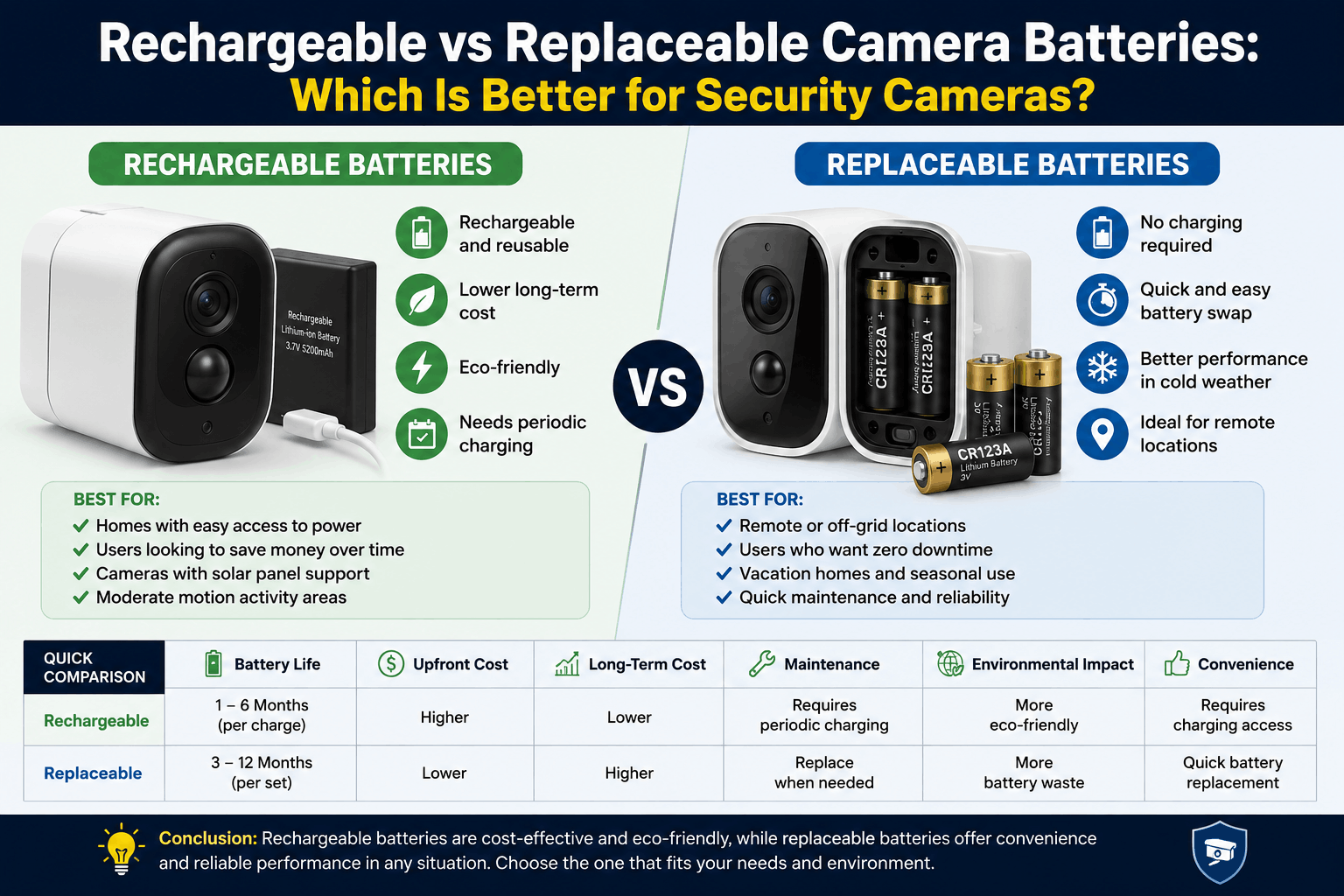
Rechargeable vs Replaceable Camera Batteries: Which Is Better for Security Cameras?
What Are Rechargeable Camera Batteries?
If your batteries can be recharged and reused 100 of times, it is known as rechargeable batteries.
These batteries are built-in or removable batteries that can be recharged.
It makes them a popular choice for modern wireless security cameras.
If your rechargeable camera battery runs out of power, you can simply connect it to a charger or USB cable, or you can use a compatible solar panel to restore its charge.
It reduces waste and lowers the long-term operating costs.
If you take rechargeable security camera batteries, it uses lithium-ion batteries because they offer high energy density, lightweight construction, and long service life.
If you take a quality lithium-ion battery, it can typically withstand several hundred charging cycles before its capacity begins to decline.
Many of these security cameras nowadays include battery management systems which protects against overcharging, overheating, and excessive discharge. It will help the extended battery life.
You can see rechargeable batteries are commonly found in battery-powered Wi-Fi security cameras designed for easy installation without electrical wiring.
If you take some of the popular models brands such as Blink, Arlo, EUfi, Reolink and Ring, these are used rechargeable battery packs or built-in lithium-ion batteries depending upon their model.
These types of cameras are ideal for homeowners who prefer a cable-free setup and if you are willing to recharge the battery every few weeks or months. Depends on the motion activity, recording settings and weather conditions.
If you choose rechargeable battery, it provides an excellent balance of convenience, performance, and long-term value.
What Are Replaceable Camera Batteries?
If your batteries are disposable until they are depleted, they are called replaceable batteries. They are removed and replaced with the new ones.
These types of replaceable batteries do not require charging. It makes them a convenient option for you, if you want continuous operation with minimal downtime.
Simply you can replace the old batteries with the fresh ones, and it will allow the camera to resume recording immediately.
I have written a post about highly rated 5 Best battery operated security cameras for colder weather conditions, you can read here,
Nowadays in the market, the most common types of replaceable batteries used in security cameras are AA lithium batteries and CR123A lithium batteries.
In both hot and cold weather, AA lithium batteries perform well and they are widely available. They typically last longer than alkaline batteries.
CR123A batteries are more compact, lightweight, and they will provide high energy output. It makes them suitable for cameras which requires reliable, long-lasting power in a small form factor.
Nowadays, many battery-powered security cameras are designed with a disposable battery system. It allows users to swap batteries in just a minute. This factor eliminates the need to wait for batteries to recharge.
It can be beneficial for vacation homes, remote properties, or locations without easy access to electricity.
Some of the models that use replaceable batteries are Blink, Ring and other wireless camera brands.
Depending upon your camera settings, motion detection frequency, video quality, and weather conditions, these replaceable batteries can power a camera for several months to over a year before it needs a replacement. It can offer dependable performance and simple maintenance.
Rechargeable vs Replaceable Camera Batteries: Key Differences
I have created a comparison table below for this to understand easily,
| Feature | Rechargeable Camera Batteries | Replaceable Camera Batteries |
|---|---|---|
| Battery Life | Typically lasts several weeks to a few months per charge, depending on camera usage. | Usually lasts several months to over a year before replacement, depending on usage. |
| Upfront Cost | Higher initial cost because the battery and charging system are included. | Lower initial cost, but replacement batteries must be purchased separately. |
| Long-Term Cost | More cost-effective since the same battery can be recharged hundreds of times. | Higher long-term cost due to recurring battery purchases. |
| Charging | Requires charging via USB cable, charging dock, or compatible solar panel. | No charging required—simply replace old batteries with new ones. |
| Maintenance | Requires periodic charging and monitoring of battery levels. | Requires occasional battery replacement but no charging. |
| Environmental Impact | More environmentally friendly because fewer batteries are discarded. | Produces more battery waste due to regular disposal of used batteries. |
| Convenience | Convenient if you have access to charging or use a solar panel. | Convenient for remote locations where charging isn’t practical and quick battery swaps are preferred. |
The key takeaway is,
Overall, rechargeable batteries are ideal for you if you are looking to reduce long-term costs and environmental impact… and,
If you are looking for replaceable batteries, they are best suited for you if you value quick maintenance and extended runtime without needing to recharge.
Battery Life Comparison
If you have a security camera, its life depends on much more than a type of battery it uses.
Some of the factors motion detection frequency, video recording settings, outdoor temperature and daily usage have a significant impact on how long a battery lasts.
| Factor | Rechargeable Batteries | Replaceable Batteries |
|---|---|---|
| Average Runtime | Typically lasts 1–6 months per charge, depending on camera usage and battery capacity. | Generally lasts 3–12 months before replacement, depending on battery type and usage. |
| Motion Detection Impact | Frequent motion events, AI detection, and live viewing drain the battery faster, requiring more frequent charging. | Heavy motion detection also reduces battery life, but fresh batteries can be replaced immediately when depleted. |
| Temperature Effects | Cold weather can temporarily reduce lithium-ion battery capacity and shorten runtime. Performance usually improves as temperatures rise. | Lithium disposable batteries generally perform better in freezing temperatures and maintain more consistent power output. |
| Recording Settings | Continuous live view, high-resolution video, long recording clips, and spotlight features consume more battery power. | The same recording settings reduce battery life, leading to earlier battery replacement. |
| Real-World Performance | Most homeowners recharge every 2–4 months under moderate activity. Solar panels can extend runtime significantly. | Many users replace batteries every 6–12 months in low-traffic areas, while busy locations may require replacements every 3–6 months. |
My Tip for you,
Whatever it may battery type, if you reduce unnecessary motion alerts, shortening recording duration, lowering video resolution when appropriate, and if you position the camera to avoid constant activity, it can significantly extend your battery life.
Which Battery Type Costs Less Over Time?
If you choose replaceable battery-powered security cameras, they usually have a lower initial purchase price, which makes them attractive for budget-conscious buyers.
However, you will need to purchase new batteries regularly, and these recurring replacement costs can add up over several years.
If you choose rechargeable camera batteries, it often costs more upfront because it includes built-in lithium-ion batteries or rechargeable battery packs.
These types of batteries require a small amount of electricity for charging, but the energy cost is minimal, typically it will be around a few dollars over several years.
If you take for a five-year ownership period, I can say that rechargeable batteries are generally the more economical choice.
It offers significant savings while reducing battery waste.
You can choose replaceable batteries, it is best suited for occasional use or remote locations where charging is inconvenient.
Pros and Cons of Rechargeable Camera Batteries
Rechargeable camera batteries are a popular choice for modern wireless security cameras because they offer long-term savings and reduce environmental waste.
However, they also require regular charging and may not be ideal for every installation.
Advantages
- Lower long-term operating costs since the batteries can be recharged hundreds of times.
- More environmentally friendly by reducing the number of disposable batteries sent to landfills.
- Compatible with solar panels on many security cameras for extended or nearly continuous operation.
- Provide reliable performance for everyday home security monitoring.
- Convenient for homeowners who don’t want to buy replacement batteries regularly.
Disadvantages
- Require periodic charging, which may temporarily take the camera offline unless a spare battery is available.
- Cold weather can reduce battery capacity and shorten runtime.
- Battery performance gradually declines after hundreds of charging cycles.
- Higher initial purchase price compared to cameras that use disposable batteries.
- Charging may be inconvenient for cameras installed in hard-to-reach locations.
Best Use Cases
- Homes with reliable access to electricity for regular charging.
- Homeowners looking to reduce long-term maintenance costs.
- Properties where solar panel charging can be used.
- Areas with moderate motion activity that don’t require constant battery replacement.
- Users who prioritize sustainability and lower environmental impact over time.
Pros and Cons of Replaceable Camera Batteries
Replaceable camera batteries are a practical option for users who want uninterrupted operation without waiting for batteries to recharge. They are especially useful for cameras installed in remote locations or areas where access to power is limited. However, the ongoing cost of purchasing new batteries should be considered before choosing this battery type.
Advantages
- No charging required—simply replace depleted batteries with new ones.
- Quick battery swaps minimize camera downtime.
- Excellent for remote locations without easy access to electricity.
- Lithium disposable batteries perform well in cold weather.
- Ideal for users who prefer simple maintenance without charging schedules.
Disadvantages
- Higher long-term costs due to frequent battery replacements.
- Generates more environmental waste from discarded batteries.
- Battery availability may be an issue during emergencies or supply shortages.
- Performance depends on using high-quality lithium batteries.
- Frequent replacements may be needed in high-traffic areas with constant motion detection.
Ideal Users
- Owners of vacation homes or seasonal properties.
- Users with cameras installed in remote or off-grid locations.
- Homeowners who want the fastest maintenance with minimal downtime.
- People who don’t want to manage regular charging schedules.
- Users who need reliable performance in cold climates.
Emergency Situations
Replaceable batteries are particularly useful during power outages, extended travel, or emergencies where charging isn’t possible. Keeping a supply of spare lithium batteries allows you to restore camera operation within minutes, ensuring continuous security monitoring even when electricity or charging equipment is unavailable.
Frequently Asked Questions (FAQs)
1. Which is better: rechargeable or replaceable camera batteries?
Rechargeable batteries are generally better for long-term savings and reducing environmental waste, while replaceable batteries offer quick battery swaps and longer runtime without needing to recharge. The best choice depends on your budget, camera location, and maintenance preferences.
2. How long do rechargeable camera batteries typically last?
Most rechargeable security camera batteries last between 1 and 6 months on a single charge, depending on motion detection frequency, video quality, live viewing, weather conditions, and overall camera usage.
3. Are replaceable batteries more expensive over time?
Yes. Although cameras with replaceable batteries often have a lower upfront cost, purchasing new batteries regularly can significantly increase the total cost of ownership over several years compared to rechargeable battery systems.
4. Which battery type works better in cold weather?
Replaceable lithium batteries generally perform better in freezing temperatures than rechargeable lithium-ion batteries. Cold weather can temporarily reduce the capacity and runtime of rechargeable batteries, requiring more frequent charging.
5. Can I extend the battery life of my security camera?
Yes. You can extend battery life by reducing motion sensitivity, shortening video recording length, limiting live viewing, lowering video resolution when appropriate, installing the camera in a low-traffic area, and using a compatible solar panel for rechargeable battery models.