
Last Updated on August 30, 2026 by Shakitha
Apartment entrance security is one of the most important first line of defense against unauthorized visitors, package theft, and other security concerns.
If you are living in an apartment with installation restrictions, then choosing between a wireless and wired security camera can be challenging for you.
Both of these options offer unique advantages and disadvantages, but the right choice depends on some of the factors like video quality, reliability, ease of installation, maintenance, and your lease agreement.
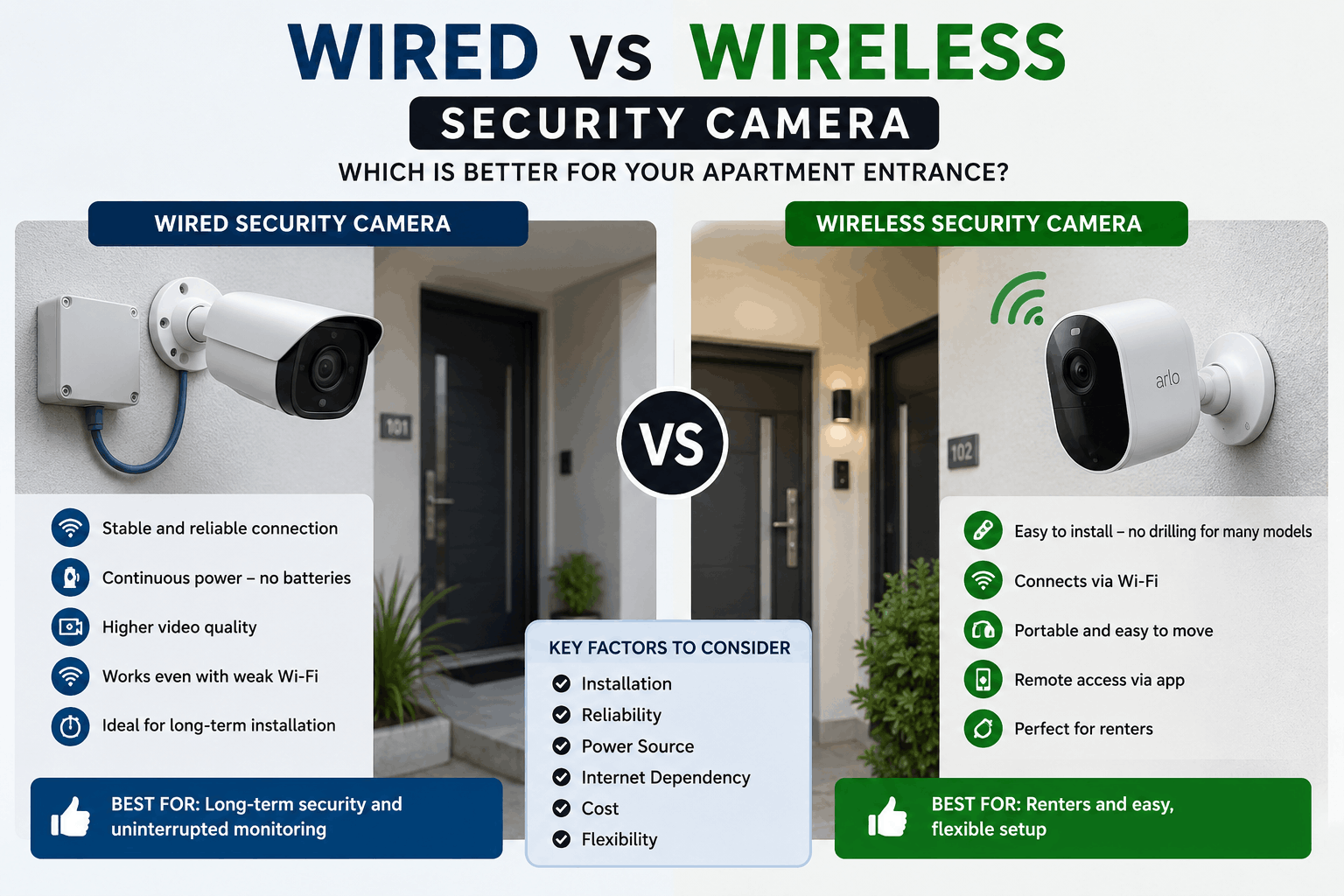
If you are a renter, then wireless cameras are best suitable for you, because they require minimal setup. Whereas wired cameras provide stable performance and continuous power.
In this post, I will compare wireless versus wired camera for apartment entrances to help you choose the best option for your security needs.
Wireless vs Wired Cameras for Apartment Entrances: Which Is Better?
What Is the Difference Between Wireless and Wired Security Cameras?
Both the wireless and wired security cameras are designed to monitor your apartment entrance.
But they differ in how they receive power, transmit video, and are installed.
If you take a wireless camera, they are typically use WiFi to send footage to mobile app or cloud storage. They are often powered by rechargeable batteries or a nearby power outlet. They are easy to install, which makes them ideal for renters who cannot drill holes or run cables.
If you take wired cameras, it uses physical cables for power and data transmission, or connect to a recorder. It is more stable and reliable connection. They are best suited for permanent installation where long-term performance is the priority.
Right below, I have provided the difference between wireless versus wired security camera with a comparison table for your easy understanding.
I have written a post about the best performing security cameras for your apartment front door, read my post here,
| Feature | Wireless Security Camera | Wired Security Camera |
|---|---|---|
| Connection Type | Connects via Wi-Fi | Uses Ethernet, coaxial, or dedicated cables |
| Power Source | Rechargeable battery or power adapter | Continuous power through electrical wiring or PoE |
| Installation | Quick and easy, usually no drilling required | More complex, often requires drilling and cable routing |
| Best For | Renters and temporary installations | Homeowners or permanent installations |
| Video Reliability | Depends on Wi-Fi signal strength | Stable and consistent connection |
| Internet Dependency | Usually requires Wi-Fi for remote access and cloud features | May continue recording locally even if the internet is unavailable |
| Maintenance | Requires battery charging or replacement (battery models) | Minimal maintenance after installation |
| Video Quality | High quality but may be affected by network congestion | Consistently high-quality video with minimal interruptions |
| Flexibility | Easy to relocate or reposition | Difficult to move once installed |
| Initial Cost | Lower installation cost | Higher installation cost due to wiring |
| Long-Term Cost | Battery replacements or cloud subscription may add costs | Lower ongoing maintenance costs |
| Ideal Apartment Choice | Excellent for most renters | Suitable only if wiring is permitted by the landlord |
Wireless Cameras for Apartment Entrances: Pros and Cons
For apartment entrances, wireless security cameras are the most popular choice because they are simple to install and require very little to no modification of the property.
These wireless cameras connect to your Wi-Fi network and allow you to monitor your front door from anywhere using a smartphone app.
These cameras offer flexibility and more convenience, and they also have a few limitations such as battery maintenance and reliance on a stable internet connection.
Below, I have provided the advantages and disadvantages for you to decide whether a wireless camera is the right choice for your apartment.
Pros of Wireless Cameras
- Easy to install without drilling or extensive wiring.
- Ideal for renters who cannot make permanent changes.
- Can be mounted using adhesive strips, magnetic mounts, or clamps.
- Supports remote live viewing through a smartphone app.
- Offers instant motion detection alerts and notifications.
- Easy to move or reposition if you change apartments.
- Many models support cloud and local storage options.
- Available in a wide range of price points and features.
- Quick setup, often completed in just a few minutes.
- Compatible with smart home systems like Alexa and Google Assistant.
Cons of Wireless Cameras
- Battery-powered models require regular recharging or battery replacement.
- Performance depends on a strong and stable Wi-Fi connection.
- Weak Wi-Fi signals can cause delayed notifications or video lag.
- Cloud storage may require a monthly subscription fee.
- Battery life may decrease in extreme hot or cold weather.
- Limited recording time on battery-powered models to conserve power.
- Wi-Fi interference from neighboring apartments can affect performance.
- Higher-end wireless cameras can be more expensive than basic wired models.
- Internet outages may limit remote viewing and cloud recording features.
- Security depends on using strong passwords and enabling two-factor authentication to reduce hacking risks.
Wired Cameras for Apartment Entrances: Pros and Cons
Wired security cameras are most popular for their continuous power supply, stable video transmission, and performance.
Wired cameras when compared to wireless cameras, they do not really heavily on WiFi for recording, making them a reliable option for long-term security.
Installing a wired camera in your apartment can be challenging because they need cables, drilling or landlord approval.
Before you choosing a wired camera, you should know the advantages and disadvantages to determine whether it suits for your apartment.
Pros of Wired Cameras
- Provides a stable and uninterrupted video connection.
- Delivers consistent high-quality video with minimal lag.
- Continuous power means no battery charging or replacement.
- Suitable for 24/7 recording without power-related interruptions.
- Less affected by Wi-Fi interference or weak signals.
- Often supports local recording on an NVR or DVR for added reliability.
- Better suited for long-term or permanent security installations.
- Lower ongoing maintenance compared to battery-powered cameras.
- Can continue recording locally even if the internet connection is lost (depending on the system).
- Generally offers lower latency for real-time monitoring.
Cons of Wired Cameras
- Installation is more complicated and time-consuming.
- May require drilling holes and routing cables through walls.
- Often requires permission from the landlord or property manager.
- Higher installation costs, especially if professional installation is needed.
- Difficult to relocate once installed.
- Visible cables may affect the appearance of your apartment entrance.
- Limited flexibility when changing the camera’s position.
- Installation may not be allowed in rental apartments with strict lease agreements.
- Power outages can interrupt recording unless a backup power supply (UPS) is used.
- Repairs or upgrades may require additional wiring work.
Side-by-Side Comparison: Wireless vs Wired Apartment Cameras
| Feature | Wireless Camera | Wired Camera |
|---|---|---|
| Installation | Quick and simple; usually no drilling required | More complex; often requires drilling and cable routing |
| Power Source | Rechargeable battery or power adapter | Continuous electrical power or Power over Ethernet (PoE) |
| Connectivity | Wi-Fi | Ethernet, coaxial cable, or PoE |
| Video Quality | High quality but may vary with Wi-Fi strength | Consistently high-quality video with stable transmission |
| Reliability | Depends on Wi-Fi signal and battery level | Highly reliable with minimal connection interruptions |
| Recording | Cloud storage and/or microSD card | Local DVR/NVR recording and cloud options (varies by model) |
| Internet Dependency | Needed for remote viewing and most cloud features | Local recording can continue even if the internet is unavailable |
| Maintenance | Requires battery charging or replacement (battery models) | Very little maintenance after installation |
| Flexibility | Easy to move and reposition | Fixed installation with limited mobility |
| Installation Cost | Lower, often DIY-friendly | Higher due to wiring and possible professional installation |
| Best for Renters | ✔ Excellent choice | ✘ May require landlord approval |
| Best for Homeowners | ✔ Good option | ✔ Excellent for long-term security |
| Smart Home Integration | Widely supports Alexa, Google Assistant, and mobile apps | Supported by many modern systems, depending on the brand |
| Security During Wi-Fi Issues | May lose live viewing or cloud recording | Local recording often continues without interruption |
| Overall Recommendation | Best for convenience and rental apartments | Best for maximum reliability and permanent installations |
Which Camera Is Better for Renters?
If you are a renter, I can say that a wireless security camera is the better choice.
Because it offers easy installation without requiring permanent modification to the apartment.
Many of these wireless camera can be mounted using adhesive strips, magnetic brackets, or clamp mounts.
It helps you to avoid drilling holes and comply with lease agreements.
They are also portable, allowing you to remove and reinstall the camera when moving to a new apartment.
If you take a wired camera, they provide more reliable performance and they often require cable routing and landlord approval.
Which Camera Provides Better Security and Reliability?
When it comes to reliability and security, I choose wired security cameras because they have many advantages.
These wired security cameras provide a stable connection, continuous power, and uninterrupted recording without relying on battery or Wi-Fi signal strength.
So, they are very likely to experience video delays, connection drops, or missed events.
However, nowadays modern wireless cameras have become highly dependable, especially when connected to a strong Wi-Fi network and properly maintained.
They can offer excellent video quality, smart motion detection, and remote monitoring, which makes it suitable for most of the apartment entrances.
You should first decide your requirement.
If maximum reliability is your priority, you can go for wired cameras.
If you choose convenience and flexibility, you can choose wireless camera for your appointment.
Frequently Asked Questions
1. Are wireless or wired cameras better for apartment entrances?
Wireless cameras are generally better for apartment entrances because they are easy to install, require little or no drilling, and can be removed when you move. Wired cameras provide greater reliability but may require landlord approval and professional installation.
2. Can I install a wired security camera in a rented apartment?
Yes, but it depends on your lease agreement and landlord’s permission. Wired cameras often require drilling holes and running cables, which may not be allowed in many rental properties. Always check your apartment rules before installation.
3. Do wireless security cameras work without Wi-Fi?
Some wireless cameras can record footage locally to a microSD card without Wi-Fi, but features like remote viewing, cloud storage, and instant motion alerts usually require an internet connection.
4. Which type of camera requires less maintenance?
Wired cameras generally require less maintenance because they receive continuous power and do not need battery charging. Wireless battery-powered cameras require periodic recharging or battery replacement to keep them operating.
5. What should renters consider before choosing a security camera?
Renters should consider their lease restrictions, installation method, Wi-Fi signal strength, power source, storage options, and whether they need a portable camera that can be easily removed when relocating. A no-drill wireless camera is usually the most practical choice.