
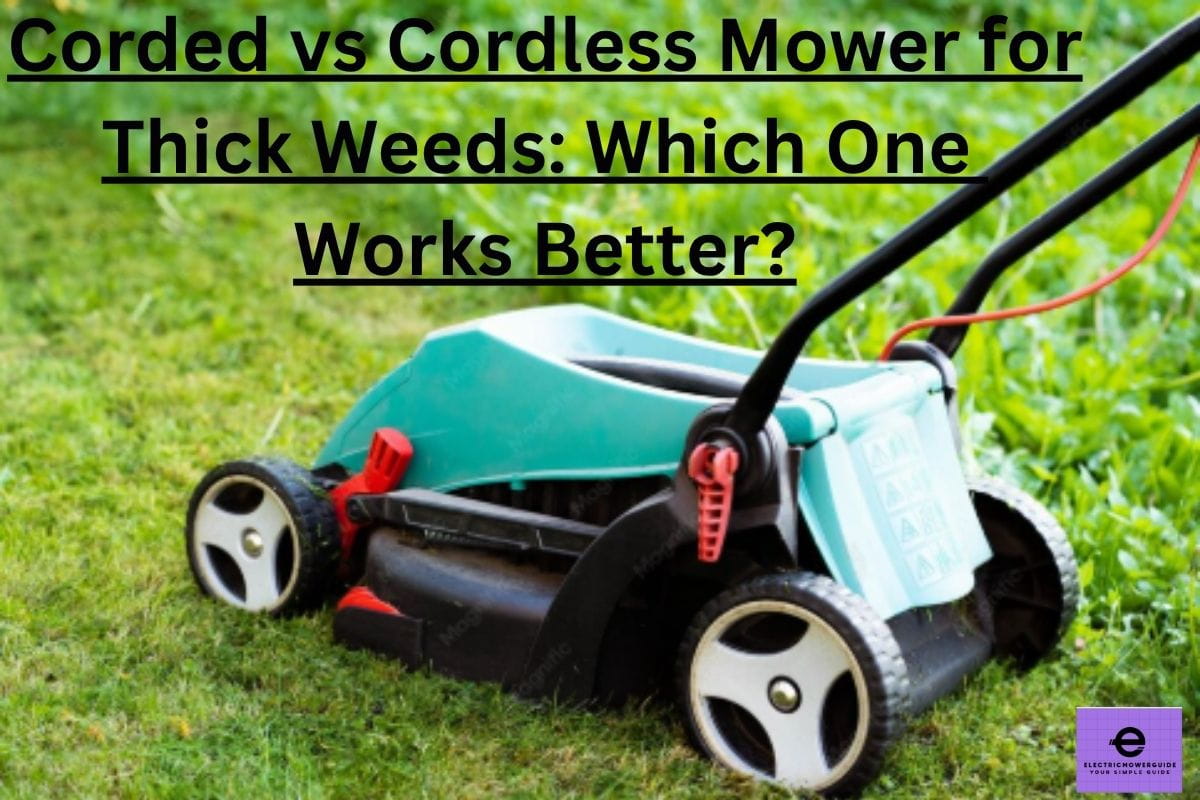
Last Updated on May 11, 2026 by Shakitha
When you use the wrong type of mower for cutting thick weeds, it can be challenging.
When dealing with dense grass, tall weeds, or overgrown lawns, many homeowners struggle to decide between corded and cordless electric mowers.
Both corded and cordless options offer unique advantages, but their performance can vary depending on run time, mobility, power, and lawn conditions.
If you use corded mower, it will provide continuous power without battery limitations.
In other hand, if you use cordless models, it offers great freedom and mobility.
If you choose the right mower, it can make weed cutting faster, cleaner, and less stressful.
In this guide, we will explore a corded vs cordless mower for thick weeds. This guide will help you find the best option for your yard.
Corded vs Cordless Mower for Thick Weeds: Which One Works Better?
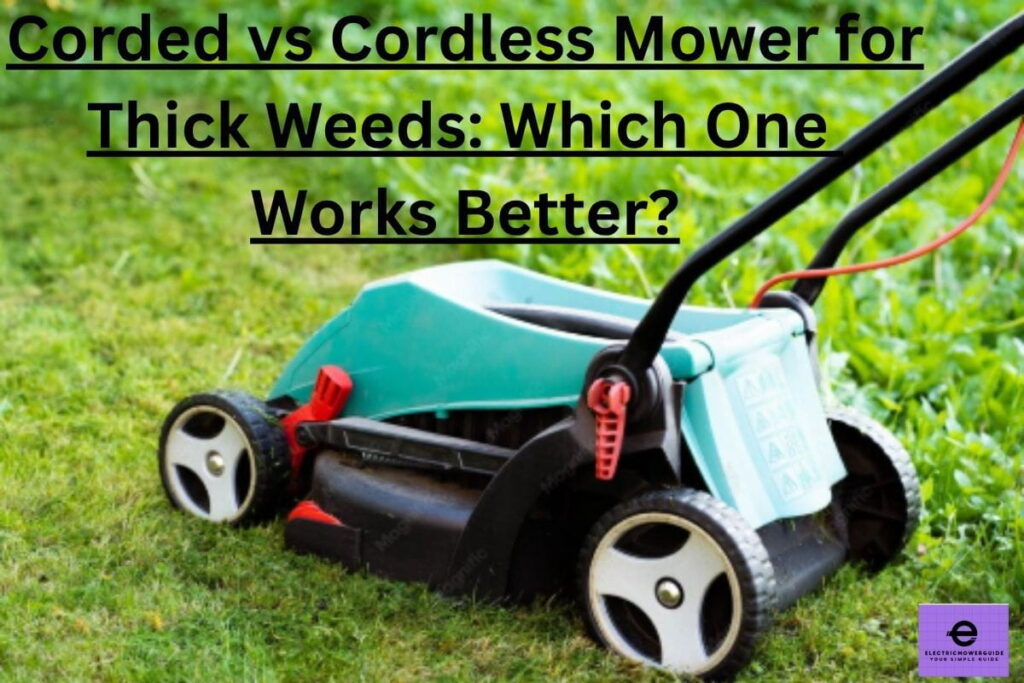
What Makes Thick Weeds Difficult to Cut?
Thick weeds are usually tougher, denser, and often taller than the regular lawn grass. So it is difficult to cut.
If those weeds are wet or heavily overgrown, their strong stems can place extra strain on the mower’s motor and blades.
This dense vegetation can also reduce air flow, slow blade rotation, clog the mower deck, which makes cutting less efficient.
Hidden debris beneath tall weeds and uneven ground add another challenge, increasing the risk of blade damage or motor overload.
These electric lawn mowers may struggle, if they lack enough power or torque.
If you want to handle thick weeds effectively, you need proper mowing technique and the right mower type.
I suggest you to see my post My top pick mowers to cut thick weeds, if you are struggling on your lawn this season.
Corded vs Cordless Mower for Thick Weeds: Quick Comparison
Here is a quick comparison table for your easy reference
| Feature | Corded Mower | Cordless Mower |
|---|---|---|
| Power Supply | Runs through direct electricity connection | Powered by rechargeable batteries |
| Performance on Thick Weeds | Delivers consistent power for dense weeds | Performance depends on battery capacity |
| Runtime | Unlimited runtime while plugged in | Limited by battery life |
| Mobility | Restricted by extension cord length | Greater freedom of movement |
| Cutting Power | Strong and steady cutting performance | Powerful models available, but may weaken as battery drains |
| Best for Large Overgrown Areas | Suitable if power outlets are nearby | Better for large yards without cord restrictions |
| Maintenance | Minimal maintenance required | Battery care and charging needed |
| Weight | Usually lighter without heavy battery | Slightly heavier due to battery pack |
| Convenience | Cord management can be frustrating | Easier to maneuver around obstacles |
| Cost | Generally more affordable | Higher upfront cost because of batteries |
| Noise Level | Quiet compared to gas mowers | Also quiet and eco-friendly |
| Ideal User | Homeowners needing nonstop power for thick weeds | Users wanting portability and convenience |
How Corded Mowers Perform on Dense and Overgrown Weeds
If you use corded mowers on dense and overgrown weeds, it will perform well because they provide continuous power without battery drain.
Even when mowing thick patches of weeds or tall grass, this mower can perform well because there is a steady electricity supply which helps maintain blade speed and cutting strength.
Unlike some cordless models, these corded mowers do not lose torque during long mowing sessions.
This factor makes it reliable for heavy-duty lawn work.
When you choose a high amp corded mower, it can cut through stubborn vegetation with fewer slowdown and cleaner results.
But you should also consider factors like blade sharpness and mowing techniques for the better performance.
The only drawback is managing the extension cord. It can be inconvenient, but corded mowers remain a strong option for handling thick weeds efficiently.
Can Cordless Mowers Handle Thick Weeds Efficiently?
Nowadays many modern cordless mowers models are available in the market.
These modern models with high voltage batteries and brush-less motors electric mowers perform well on handling thick weeds efficiently.
These cordless mowers deliver strong cutting power and enough torque to handle dense weeds, tall grass and overgrown areas.
One of their biggest advantage is their mobility. It allows users to move freely without dealing with extension cords.
The drawback is these thick weeds place extra strain on the battery. So it can reduce the runtime and slightly lower the performance during long mowing session.
If you want improved results you should use sharp blades, fully charged battery and slower moving speed.
To achieve a clean and even cut for very dense or wet weeds, you need to pass in multiple session.
Power and Torque Differences Between Corded and Cordless Models
For your easy understanding, I have provided it with a comparison table below,
| Feature | Corded Mower | Cordless Mower |
|---|---|---|
| Power Source | Direct electricity from outlet | Rechargeable lithium-ion battery |
| Power Consistency | Continuous and stable power output | Can decrease as battery drains |
| Torque Strength | Strong steady torque for thick weeds | High torque in premium models, varies by battery size |
| Performance on Dense Weeds | Excellent for prolonged heavy cutting | Good, but may slow in extremely dense patches |
| Motor Type | Usually high-amp electric motor | Often brushless battery-powered motor |
| Runtime Impact | No runtime limitations | Limited by battery capacity and charge |
| Cutting Efficiency | Maintains blade speed consistently | Blade speed may reduce under heavy load |
| Best Use Case | Long mowing sessions with heavy weeds | Medium to large lawns needing mobility |
| Overheating Risk | Lower during continuous operation | Higher during intense cutting sessions |
| Weight Distribution | Lighter without battery pack | Heavier because of battery weight |
| Mobility | Restricted by extension cord | Excellent freedom of movement |
| Overall Thick Weed Capability | Reliable for continuous heavy-duty mowing | Effective with high-voltage batteries and sharp blades |
Best Features to Look for in a Mower for Thick Weeds
For easy cutting and more effective cutting on thick weeds, there are several important features you need to consider on your electrical lawnmower.
You should look for a powerful motor or high voltage battery. These are essential for maintaining blade speed in dense vegetation.
To handle the tough stems without clogging, you should look for sharp, durable steel blades.
To reduce the strain on the mower, you should look for adjustable cutting height. It will manage tall weeds gradually.
To cover more ground quickly, look for wider cutting deck feature.
If you are mowing on uneven terrain, you should choose the mower with larger rear wheels which improves movement.
For better efficiency and longer lifespan, you should look for brush-less motors.
If you are choosing cordless model, look for long battery run time and fast charging options available.
FAQs
1. Are corded or cordless mowers better for thick weeds?
Corded mowers are generally better for continuous heavy-duty cutting because they provide steady power without battery limitations. Cordless mowers offer more mobility and convenience but may require extra battery power for dense weeds.
2. Can a cordless mower cut tall and overgrown weeds?
Yes, modern cordless mowers with high-voltage batteries and brushless motors can cut tall weeds effectively. However, very thick or wet weeds may require slower mowing speeds or multiple passes.
3. Do thick weeds damage electric mowers?
Thick weeds can strain the motor and blades if the mower is underpowered or poorly maintained. Keeping blades sharp and avoiding extremely wet vegetation helps prevent damage.
4. What mower blade is best for thick weeds?
Heavy-duty steel blades with sharp cutting edges are best for thick weeds because they provide cleaner cuts and reduce clogging during mowing.
5. How can I improve mowing performance on dense weeds?
Mow gradually, avoid cutting wet weeds, use the highest cutting height first, and keep the blades sharp. For cordless mowers, always start with a fully charged battery.