
Last Updated on March 22, 2026 by Shakitha
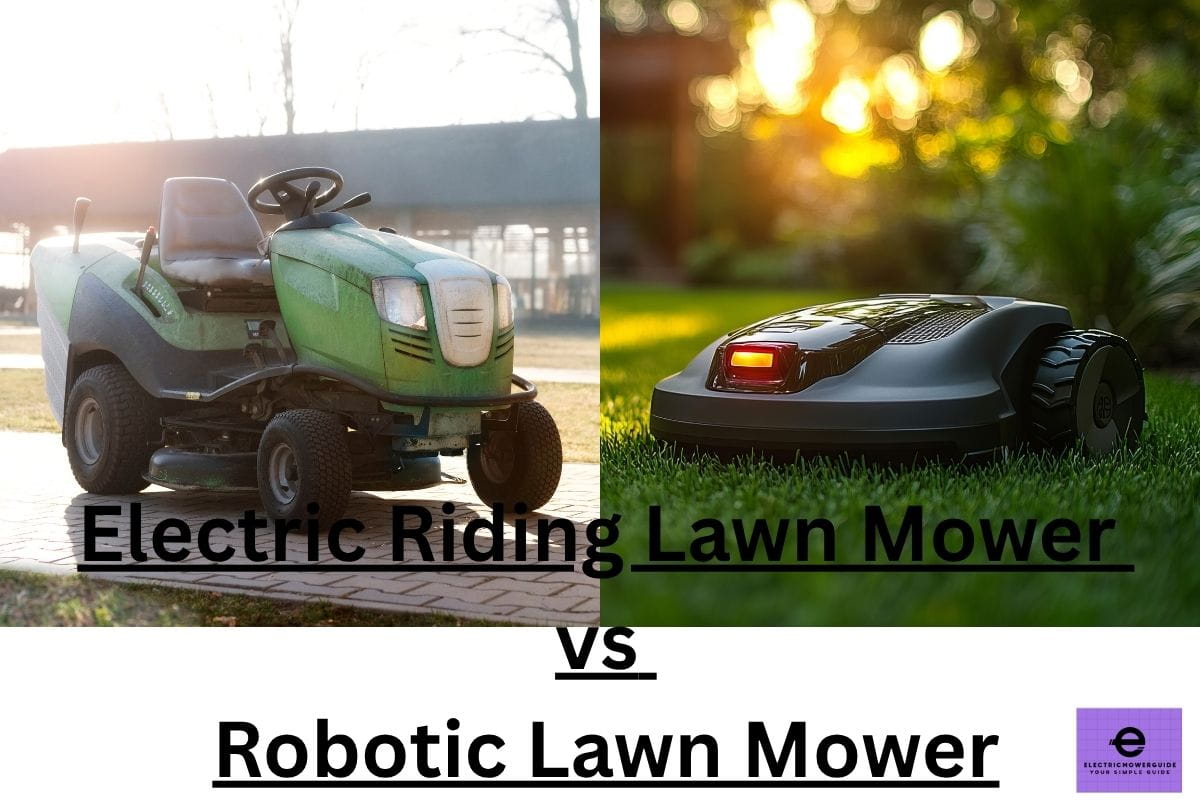
Are you deciding between a high-end electric riding mower and a modern robot ? (electric riding mower vs robotic mower) It is no longer just about laziness, it’s about how you value your weekends.
In my years of tracking the mower technology, the gap has closed significantly.
While I use an electric riding mower, it gives me the raw power and the satisfaction of finishing a two-acre job in an hour. On the other hand, when I used 2026’s robot mower, they are “set and forget” marvels that keep your turf at a constant, golf-course height.
I will say like this, Whether you enjoy the seat time in the electric riding mower or want to reclaim your Saturday mornings entirely, choosing the right technology entirely depends on your
- Yard’s complexity and
- Your tolerance for maintenance.
Electric Riding Lawn Mower vs Robotic Lawn Mower
Lets break down one by one to find out which is better,
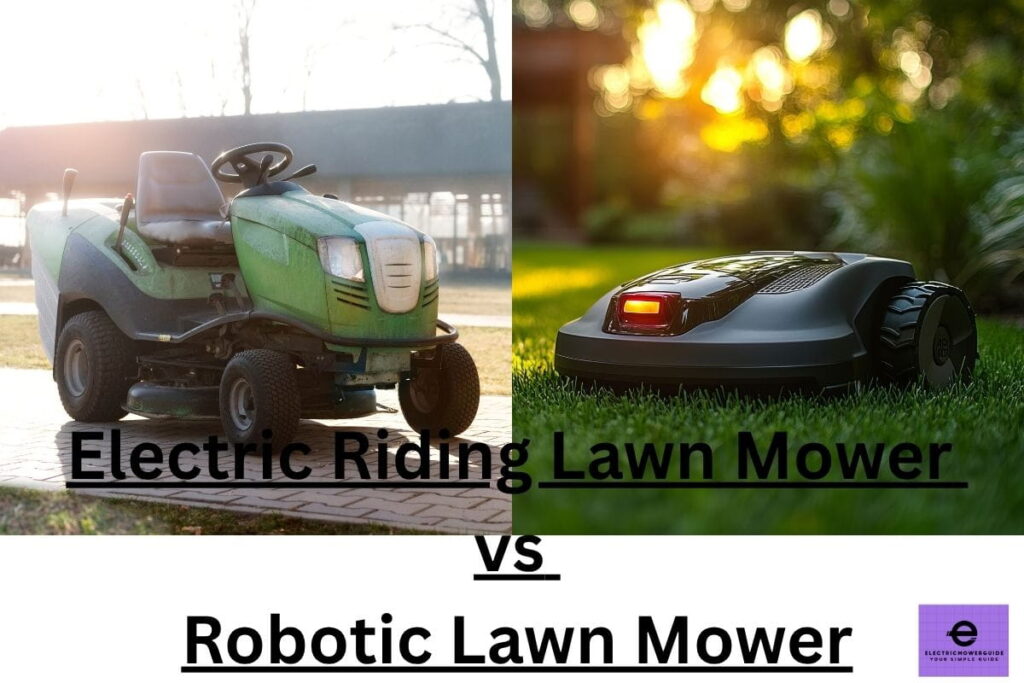
Wire-free robotic mower
What I feel nowadays, is that the “boundary wire” era of robotic mowing is officially dead.
In 2026, if you aren’t looking at wire-free navigation, you’re buying yesterday’s headache.
I see robotic mowers use Modern units RTK-GNSS (satellite GPS with centimeter-level accuracy) or LiDAR to map your yard in minute.
There will be no more burying cables or chasing down wire brakes with a radio.
In my experience, the real win isn’t just the easy setup; it’s the flexibility.
If you add a flower bed or a backyard fire pit, you just update the “no-go zone” in your app rather than digging up your lawn.
These machines handle complex layouts that would have baffled older robots, making them a legitimate hands-off solution for even the most manicured properties.
It’s finally the “set and forget” technology we were promised a decade ago.
Acreage mowing capacity
I can see that, acreage capacity is where the “riding vs. robot” debate gets real.
In my experience, if you’re pushing past the two-acre mark, an electric riding mower is still the undisputed heavyweight.
It’s about raw speed and battery density; you can knock out a massive field in ninety minutes and be done with it.
However, 2026’s high-end robots have flipped the script with “continuous mowing.”
A robot doesn’t need to finish the lawn in one charge, it just works 24/7, nibbling away.
While a rider handles a three-acre lot in one go, a modern AWD robot manages that same space by never stopping.
The real question is whether your turf is a wide-open meadow or a complex obstacle course.
If it’s a big, open stuff, the rider’s deck width usually wins.
Lithium-ion battery lifespan
Today, the biggest mistake people make is treating a mower battery like a AA alkaline, use it until it’s dead, then shove it in a drawer.
In my experience, lithium-ion lifespan is all about heat and voltage management.
These packs aren’t cheap, but if you treat them right, they’ll easily go five to eight seasons before you notice a real drop in runtime.
The “silent killers” are
- extreme temperatures and
- leaving them at 0% or 100% for months.
Usually, I tell everyone:
don’t fast-charge a hot battery right after a long mow, and never let it sit empty in a freezing shed.
If you keep the cells in that 20% to 80% “comfort zone” during the season and store them at half-charge in the winter, you’re essentially doubling the life of the most expensive part of your machine.
It’s the difference between a five-year investment and a ten-year one.
RTK-GNSS navigation
I can clearly say it like this, Think of RTK-GNSS as the “surgical precision” upgrade for standard GPS.
While your phone’s GPS might be off by several meters, that is fine for driving, but a disaster for a lawn.
RTK uses a local base station to cross-reference satellite signals and correct errors in real time.
In my experience, this is what finally made wire-free mowing viable.
It brings accuracy down to about 2–3 centimeters, allowing the robot to mow in perfect, professional stripes rather than wandering like a confused Roomba.
Just keep in mind: it needs a clear view of the sky. If your yard is buried under heavy tree canopies, you’ll want a model that reinforces RTK with vision or LiDAR to prevent it from getting “lost” under the oaks.
Comparison Table
This quick comparison table, will answer you some of the questions you have,
| Feature | Electric Riding Mower | Robotic Mower (2026 Tech) |
| Human Effort | High (Requires driving) | Zero (Fully autonomous) |
| Mowing Speed | Fast (30–60 mins/acre) | Slow (Continuous daily cycles) |
| Terrain | Best for rough/thick grass | Best for maintained turf |
| Max Slope | Generally up to 15° | Up to 40° (AWD models) |
| Storage | Needs garage/shed space | Compact weatherproof dock |
| Primary Tech | Electric drivetrain | RTK, LiDAR, & AI Vision |
Zero-turn electric mower
Think like this, If a standard tractor is a sedan, a zero-turn electric mower is a sports car.
The “zero-turn” name comes from the dual-motor steering that lets the machine spin on its own axis, To be clearly explained, you can pull a 180-degree turn without leaving a single blade of grass uncut.
In my experience, the real magic happens when you hit obstacles. Instead of the “three-point turn” dance around every tree or flowerbed, you just pivot and keep moving.
It’s easily 40% faster than a traditional rider, and in 2026, models like the EGO Z6 or Ryobi’s 80V series offer instant torque that gas engines just can’t match.
You get professional-grade speed and precision without the noise or vibration, making it the ultimate tool for reclaiming your Saturday.
Final Conclusion
Ultimately, the “best” mower isn’t about the specs, it’s about how you want to spend your Saturday morning.
In my 10 years of experience, I can say that, If you find peace in the driver’s seat and want the power to tackle a tall field in one go, a high-torque electric riding mower is your best bet.
However, if you’re ready to outsource the labor entirely, the 2026 generation of wire-free robots has finally made “zero-effort” lawn care a reality.
My personal advice is,
Audit your yard first.
Wide-open acreage still favors the rider’s speed, while complex, obstacle-heavy lawns are where a precision robot truly shines.
Either way, ditching gas is the smartest investment you’ll make this year.